We, the Texas Experienced Student Leaders, were at the Medical-Legal Partnership conference on April 16th, where we spoke about the intersection of medicine and law in our efforts to advance abortion and reproductive healthcare education through Medical Students for Choice.
We talked through our experiences at medical school and with Medical Students for Choice, addressing the topics of Medical Education, Advocacy, and Patient Care as a part of our presentation. Below, we each wrote about what we discussed at the conference and the impact Medical Students for Choice had on our education.
Natalie:
I came to medical school knowing I wanted to be an OB/GYN, and reproductive health was never an abstract interest for me. When I started medical school in June 2023, I assumed abortion and reproductive healthcare would be taught the way every other medical procedure is taught, factually, thoroughly, and without apology. Unfortunately, I was wrong.
What I encountered instead was an institution operating out of fear that continued to grow throughout my years of medical school. I realized that if I wanted a real education in reproductive healthcare, I would have to build it myself and seek it out elsewhere. That realization was both frustrating and motivating, and it is what drove me deeper into Medical Students for Choice. As a local MSFC chapter leader, faculty and administration pushed back on campus events such as a Planned Parenthood talk, a papaya manual vacuum aspiration workshop, and anything that might be perceived as touching a political nerve in our restricted state. The message, even when unspoken, was clear: this topic is dangerous and risky.
MSFC became the structure through which I could fight back. As Vice President of the Texas College of Osteopathic Medicine (TCOM) chapter and later as a State of Texas Experienced Student Leader, I found not just community but purpose and a way to turn frustration into action.
- Attending the MSFC Abortion Training Institute was the most incredible educational experience of my medical school career, giving me hands-on training in medication and procedural abortion that my curriculum never provided.
- In creating Project H.E.R., I found something that felt concrete and immediate in a fight that can often feel overwhelming and abstract. Addressing period poverty meant I could walk into my own community and see the direct impact of my work in the hands of the people receiving it.
- Being featured in CNN was another defining moment. That coverage reminded me that medical students are not just future physicians waiting in the wings, but part of this conversation right now.
- Lobbying on Capitol Hill was one of the most terrifying experiences of my life. Walking those echoing halls surrounded by physicians fluent in a language of policy I was still learning, every instinct telling me I did not belong there, but choosing to speak anyway became one of the most important things I have done.
- Leading Sister Speaks workshops with young girls at the Fort Worth Boys and Girls Club served as a stark reminder that the next generation is watching, and what we teach them about their bodies, their voices, and their rights will echo forward in ways none of us can fully measure.
- Presenting at the Medical-Legal Partnership Conference was a reminder that none of us is doing this work alone. I came to medical school wanting to be a physician who could care for the whole patient, and that has not changed — but I understand now how much work it takes just to preserve that possibility. I will keep doing this work for my patients, for the students who come after me, and for the girls in those workshops who deserve a future where this fight is already won.
Uma:
I started medical school in Summer 2022, weeks after the Dobbs v. Jackson Women’s Health Organization decision took effect in Texas. I was already deeply interested in abortion and reproductive health education, but uncertain about what that would mean for my training at Texas A&M College of Medicine. This uncertainty was especially relevant given my interest in pediatrics, where understanding reproductive health is essential to patient care.
From the beginning, I knew current laws would limit what I could learn, particularly in terms of direct clinical exposure. As I progressed through training, it became clear that the impact extended beyond missed experiences. These laws have created an environment in which faculty and clinicians hesitated to speak openly, sometimes concerned that even sharing accurate information about abortion could carry risk, especially in clinical settings.
Through work with Medical Students for Choice, including leadership roles at Texas A&M and now as a Texas Experienced Student Leader supporting chapters statewide, it has been possible to help address these gaps through curriculum reform and student-led initiatives. At Texas A&M, I helped develop a reproductive health and family planning selective, organized speakers and discussions, and connected students with opportunities such as the Abortion Training Institute.
The selective in particular highlighted the value of medical-legal partnerships in Medical Students for Choice work. For one of our sessions, we have attorneys from the Center for Reproductive Rights lead a session on the legal abortion landscape, allowing students to learn directly from experts. For another session, an obstetrician-gynecologist from Houston leads discussions on reproductive ethics, demonstrating how care can vary based on location, patient age, and consent laws. And the selective as a whole highlights the value of student collaboration that comes from Medical Students for Choice.
Our chapter also collaborated with Southern Methodist University’s Law School in 2024. We served as the partner organization for a Crimes Against Women Law Clinic course, in which a group of law students developed an educational presentation for our chapter and a newsletter distributed across our medical school. Their work focused on reproductive coercion and the impact of abortion restrictions on their clients. In addition, we partnered with the If/When/How chapter at SMU Law to host a virtual meeting where law students presented on the legal landscape of abortion care in Texas and our members shared insights on the medical landscape, followed by a discussion that helped both groups better understand the broader abortion care environment. Presenting this initiative at the Medical Legal Conference highlighted the value of cross-disciplinary collaboration and underscored the importance of creating more opportunities for medical and law students engaged in reproductive healthcare to learn from one another.
Presenting this work at the conference underscored how much students have built within a restrictive environment. Conditions in Texas remain inadequate. However, Texas Experienced Student Leaders continue to fight to ensure that abortion is not excluded from medical training. We advocate for comprehensive and accurate reproductive health education and strive for a medical student body that understands the legal landscape in the region that we train – emphasizing that there is harm when students do not understand the laws that come in the way of adequate abortion care because that leads to situations where patients are denied care, even when Texas acknowledges conditions in which they should be getting abortion care. These gaps affect not only students but also the care future patients will receive. We will continue to advocate for reform across Texas, regardless of the continued political landscape, to address ongoing legislative challenges and advance full-spectrum health care.
Texas A&M’s selective was made possible by collaborators Kadambari Suri, Ella Nonni, and Diana McKinnon, and our chapter faculty mentor Rajesh Miranda. It continues to be led each year by new cohorts of Medical Students for Choice members. I am forever grateful to all the students, faculty, and administration that made the selective possible and the student advocates who have come before and after me who continue to make this work and more possible!
Rachel:
I started medical school knowing I wanted to become an obstetrician/gynecologist. I was a camp counselor for young girls for a few years in college, and I also worked with the elderly in an assisted living facility during my gap year. I knew I wanted a specialty that combined my love of working with women of all ages with my passion for preventative medicine and advocacy. I have always been a strong proponent for reproductive freedom, but it wasn’t until Roe vs Wade was overturned in 2022 that I became an active advocate for abortion access.
I had a rude awakening starting medical school in Texas in 2023 after graduating from a university in Colorado. Suddenly, I was in an environment where my belief — that abortion is a right that does not deserve to be taken from anyone — was the minority. To find like-minded people, I joined my school’s women’s health group and Medical Students for Choice chapter. It was in these groups where I found a way to continue my advocacy and education. Unfortunately, we ran into problems scheduling events on campus due to the administration’s fear of the word abortion. We went back and forth with higher-ups at the school just to be able to host an event with Planned Parenthood about abortion stigma. When this event was finally approved, we had one of the biggest turnouts that year for a student organization event. Every time we wanted to host something on campus, like an IUD workshop or a speaker event with an abortion providers, we had to justify them and jump through hoops.
I was under the misguided impression that since abortion is healthcare, this is something that would be included in our curriculum and discussed openly and factually, like other medical procedures were. Instead, what I experienced was faculty and administration leading and teaching from a place of fear of being reprimanded or losing their jobs for adequately educating their students. Abortion curriculum was virtually nonexistent at my school. We got one lecture with the basic definition of abortion and the medications that can be used to manage it, all under the umbrella of “miscarriage management”. I quickly learned that in order to get the education I wanted and deserved, I would have to seek out these opportunities for myself. I joined the Texas Abortion Advocacy Network’s 10-week course, where I learned about reproductive justice, abortion funds, what the law in Texas is, and how to be an advocate for my future patients. I went to MSFC’s Abortion Training Institute, where I learned more about medication and procedural abortion than I did in my entire 2 years of curriculum thus far, and I had the opportunity to practice these hands-on skills.
Medical Students for Choice has been so important to my education and advocacy efforts, and I am so grateful to be an Experienced Student Leader for Texas chapters. Through our work as ESL’s, we got the opportunity to present our experiences with reproductive health education in medical school at the Medical Legal Partnership conference in Fort Worth. It was very rewarding to speak at this conference full of lawyers and medical professionals, and multiple people approached me throughout the weekend with words of encouragement, along with outrage at the current system. Speaking at this conference is one of many reasons why we will continue to advocate for comprehensive reproductive health education in Texas.
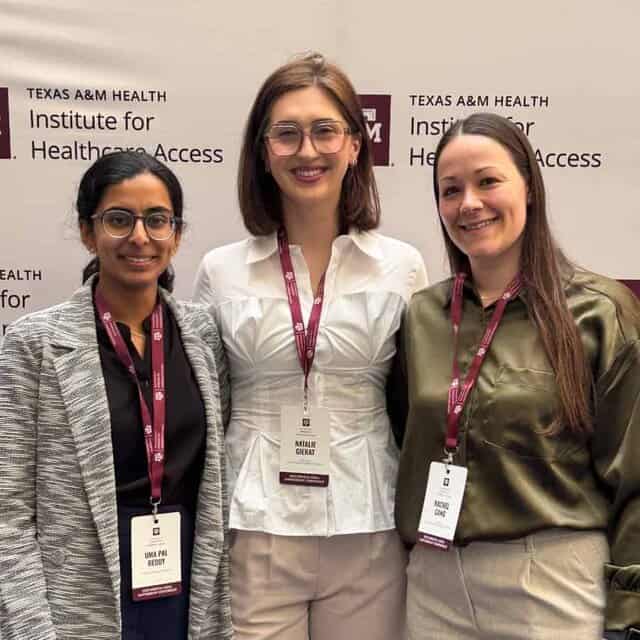
From left to right: Uma Reddy, Natalie Gierat, and Rachel Gano wearing conference badges and standing in front of a Texas A&M Institute for Healthcare Access backdrop.