I just found out that I matched. A huge sigh of relief—finally, I know that I have secured my first job as a doctor, and that I will be an OB-GYN. Friends and family immediately reached out with congratulations, many asking for details: where will I be?
I had to explain that in the U.S., there is a grueling, week-long wait between finding out that you matched and finding out where.
For many residency applicants this year—especially those pursuing specialties related to reproductive health—there is an additional layer of stress compounded onto that wait. For those of us who want to offer the full spectrum of reproductive healthcare, including abortion, matching alone does not guarantee access to the training we need.
Since the Dobbs decision eliminated the constitutional right to abortion in 2022, residency programs and applicants alike have had to navigate a constantly shifting landscape of state-level abortion restrictions — running the gamut from targeted regulations of abortion provider (TRAP) laws to outright, wholesale bans. Approximately 44% of OB-GYN residency programs in the United States are impacted by state-level abortion restrictions.¹ This means that a similar proportion of trainees may not receive comprehensive family planning training—and, as a result, may be limited in the care they can provide to their future patients.
I started medical school just months after Dobbs was decided, and its impact has shaped nearly every step of my training since. Even as a first-year student, before I knew which specialty I would choose, I knew I did not want to train in a state where abortion is restricted.
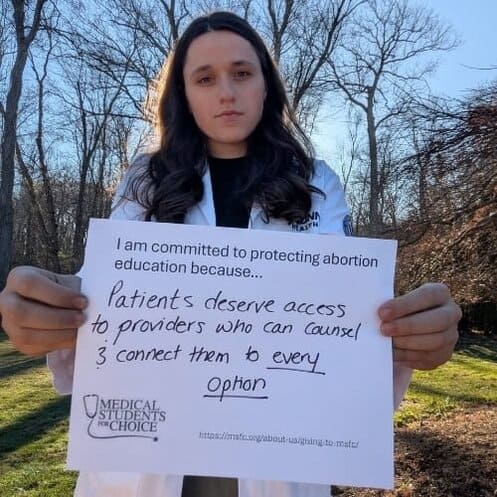
That decision came with an ethical dilemma. Patients in these states already face profound and unjust barriers to care, and I felt a sense of guilt about avoiding those communities for training—potentially contributing to an already strained landscape of access. But the reality is that residency training is formative. I know I want to provide the full scope of reproductive healthcare, including abortion. Training in a state where abortion is restricted would not only limit the care I could provide during residency, but also the skills I carry with me for years to come.
As someone from and trained in a “protective” state, I had the ability and privilege to apply only to programs where I could receive this training. So while many of us learned this week that we matched, not all have the reassurance that they will receive the training they need and deserve.
This stress is not limited to fears of inadequate training. For those who have the potential to match in restrictive states, there is also the fear of limited access to healthcare for themselves, their partners, their families, and their colleagues, which affects all medical trainees, not just those involved in the provision of reproductive healthcare.
Match Week is always stressful—but it is also meant to be celebratory. It represents years of hard work and sacrifice for medical students across the country. Yet the Dobbs decision and the wave of abortion restrictions that followed have created an impossible situation for many. Some applicants may desperately want to return home to train and serve their communities but feel they cannot. Others may feel called to fields like OB-GYN, yet are forced to choose between becoming the physician they want to be and maintaining access to essential training and care.
For those who matched this week, it is natural to feel anxious about where we will end up. But we should not have to wonder whether the program we matched into will be able to provide the training we need to care for our patients.
—
¹ Hammoud MM, Morgan HK, George K, et al. Trends in Obstetrics and Gynecology Residency Applications in the Year After Abortion Access Changes. JAMA Network Open. 2024;7(2):e2355017. doi:10.1001/jamanetworkopen.2023.55017